Saturday, April 20, 2024

The Ball and the Cross & Freud’s Last Session

The Ball and the Cross.  By G.K. Chesterton, originally published in 1909.


Freud’s Last Session.  By Mark St. Germain, Dramatists Play Service, Inc., 2010.


“Debates” about the clash between religion and atheism are rarely developed well in literature and drama.  Such presentations tend to be ham-fisted and are often slanted one way or the other.  Either the character(s) representing religion are plaster saints or pious fools, and the debates over big issues are often shallow and devoid of nuance and deep understanding of important issues. 


Just because it’s difficult to handle such subject matter well, it doesn’t mean that it can’t be done in an interesting an entertaining manner.  This review will address two creative works that address the clash between religion and atheism with style, wit, and intelligence.  The first is a novel– G.K. Chesterton’s The Ball and the Cross, and Mark St. Germain’s play Freud’s Last Session.  


Chesterton’s The Ball and the Cross is the story of two men, McIan, a staunch Catholic, and Turnbull, a public atheist running a periodical promoting secularism.  Insulted by Turnbull’s treatment of the Virgin Mary, McIan challenges Turnbull to a duel.  The two of them attempt to fight on multiple occasions, but they are always interrupted by people with different opinions on life and the world.  The two men criss-cross the country, debating and arguing all the way, though never getting the chance to turn their swords against each other.  Eventually, the pair are compelled to join forces in order to defeat a threat that could destroy England.


In one passage, the two men reflect upon their complicated intellectual sparring and how their understanding of each other’s perspectives has developed in the light of listening to each other’s ideas:


“MacIan leant his white and rather weary face back upon the cushions in order to speak up through the open door.


“Mr. Turnbull,” he said, “I have nothing to add to what I have said before. It is strongly borne in upon me that you and I, the sole occupants of this runaway cab, are at this moment the two most important people in London, possibly in Europe. I have been looking at all the streets as we went past, I have been looking at all the shops as we went past, I have been looking at all the churches as we went past. At first, I felt a little dazed with the vastness of it all. I could not understand what it all meant. But now I know exactly what it all means. It means us. This whole civilization is only a dream. You and I are the realities.”


“Religious symbolism,” said Mr. Turnbull, through the trap, “does not, as you are probably aware, appeal ordinarily to thinkers of the school to which I belong. But in symbolism as you use it in this instance, I must, I think, concede a certain truth. We must fight this thing out somewhere; because, as you truly say, we have found each other’s reality. We must kill each other—or convert each other. I used to think all Christians were hypocrites, and I felt quite mildly towards them really. But I know you are sincere—and my soul is mad against you. In the same way you used, I suppose, to think that all atheists thought atheism would leave them free for immorality—and yet in your heart you tolerated them entirely. Now you know that I am an honest man, and you are mad against me, as I am against you. Yes, that’s it. You can’t be angry with bad men. But a good man in the wrong—why one thirsts for his blood. Yes, you open for me a vista of thought.”


The title The Ball and the Cross comes from the dome of St. Paul’s Cathedral, where a cross stands on top of a ball.  In the opening scenes, one character compares the ball to the world and the cross to religion, and states that the positions of the symbols ought to be reversed to illustrate the importance of secular concerns over supernatural ones.  His debating partner, a monk, points out that if the cross were below the ball, then the pair of stacked symbols would come tumbling down due to the imbalance.


As the two characters develop a grudging friendship, the two of them begin to gain a deeper understanding of their own beliefs, and gradually conclude that their own honest and passionate worldviews are more important than the wishy-washy beliefs of people who are too wrapped up with their worldly concerns to give the idea of God’s existence a thought.


“He [McIan] stopped again, and went on with the same air of travailing with the truth:


“When I saw that, I saw everything; I saw the Church and the world. The Church in its earthly action has really touched morbid things—tortures and bleeding visions and blasts of extermination. The Church has had her madnesses, and I am one of them. I am the massacre of St. Bartholomew. I am the Inquisition of Spain. I do not say that we have never gone mad, but I say that we are fit to act as keepers to our enemies. Massacre is wicked even with a provocation, as in the Bartholomew. But your modern Nietzsche will tell you that massacre would be glorious without a provocation. Torture should be violently stopped, though the Church is doing it. But your modern Tolstoy will tell you that it ought not to be violently stopped whoever is doing it. In the long run, which is most mad—the Church or the world? Which is madder, the Spanish priest who permitted tyranny, or the Prussian sophist who admired it? Which is madder, the Russian priest who discourages righteous rebellion, or the Russian novelist who forbids it? That is the final and blasting test. The world left to itself grows wilder than any creed. A few days ago you and I were the maddest people in England. Now, by God! I believe we are the sanest. That is the only real question—whether the Church is really madder than the world. Let the rationalists run their own race, and let us see where they end. If the world has some healthy balance other than God, let the world find it. Does the world find it? Cut the world loose,” he cried with a savage gesture. “Does the world stand on its own end? Does it stand, or does it stagger?”…


 “The world has gone mad,” said MacIan, “and it has gone mad about Us. The world takes the trouble to make a big mistake about every little mistake made by the Church. That is why they have turned ten counties to a madhouse; that is why crowds of kindly people are poured into this filthy melting-pot. Now is the judgement of this world. The Prince of this World is judged, and he is judged exactly because he is judging. There is at last one simple solution to the quarrel between the ball and the cross——”


Turnbull for the first time started.


“The ball and——” he repeated.


“What is the matter with you?” asked MacIan.

“I had a dream,” said Turnbull, thickly and obscurely, “in which I saw the cross struck crooked and the ball secure——”


“I had a dream,” said MacIan, “in which I saw the cross erect and the ball invisible. They were both dreams from hell. There must be some round earth to plant the cross upon. But here is the awful difference—that the round world will not consent even to continue round. The astronomers are always telling us that it is shaped like an orange, or like an egg, or like a German sausage. They beat the old world about like a bladder and thump it into a thousand shapeless shapes. Turnbull, we cannot trust the ball to be always a ball; we cannot trust reason to be reasonable. In the end the great terrestrial globe will go quite lop-sided, and only the cross will stand upright.”


In comparison, Freud’s Last Session is an imagined conversation between two real-life figures. While there is no proof that Sigmund Freud and C.S. Lewis ever met, there is a possibility that their paths might have crossed at some point after Freud fled for London in order to escape from the Nazis.  In this play, Freud’s atheistic worldview clashes with Lewis’s Christianity, and throughout their conversation, we learn about their lives and beliefs.


The play is set on September 3, 1939, in Freud’s study in London.  Freud is 83 and Lewis is 40.  Freud’s invitation to meet Lewis soon branches into a full-fledged, emotional debate, as both men’s biographical details blend with insight as to the nature of belief and reason, all set to the backdrop of the looming Second World War.


While Chesterton’s work clearly tips the scales towards religion at the end, Freud’s Last Session doesn’t take a side.  However, McIan, Turnbull, Freud, and Lewis are all portrayed as decent, intelligent, and honorable men.  Both sides of the debate are presented in fair, interesting, and intelligent manners, by exploring why people may believe or disbelieve, Chesterton and St. Germain create powerful and compelling works.


–Chris Chan


Friday, April 12, 2024

The Lion of Münster & The Cardinal Müller Report

The Lion of Münster: The Bishop Who Roared Against the Nazis.  By Daniel Utrecht, TAN Books, 2016.


The Cardinal Müller Report: An Exclusive Interview on the State of the Church.  By Gerhard Cardinal Müller with Father Carlos Granados, translated by Richard Goodyear, Ignatius Press, 2017.


This review will cover two recent works about two prominent members of the Church hierarchy.  In The Lion of Münster: The Bishop Who Roared Against the Nazis, the life and career of Bishop Clemens August Graf von Galen, a churchman who openly spoke out about Hitler’s policies and politics, and galvanized many members of his flock as well.  The Cardinal Müller Report: An Exclusive Interview on the State of the Church looks at a contemporary and prominent figure in the Church, as Cardinal Gerhard Müller, prefect of the Congregation for the Doctrine of the Faith, explains Church teachings and the pressing moral and ethical issues of our time.


The Lion of Münster opens with a summary of Bishop von Galen’s early life, and then quickly moves to the Bishop’s open condemnation of various policies, ranging from attacking Nazis who euthanized the sick and weak, to denouncing eugenicist racial policies:


“From the beginning of his time as bishop, shortly after Hitler took power, Clemens August von Galen had attacked the Nazi racial theories.  In the middle of 1941, when Germany’s war successes were at their height, he openly reprimanded the Gestapo for confiscating the houses of religious orders.  He had denounced the secret practice of deliberately putting sick and disabled people to death and, it seemed, had an influence in stopping it.”


Many historians and pundits have attacked the Church for remaining silent during WWII, but the work of recent historians has largely contradicted that view, refining certain allegations and outright contradicting others.  Several of these works have been addressed in recent reviews, such as Catholics Confronting Hitler and A Man for Others (both November, 2016), and Church of Spies (November, 2015).  In The Lion of Münster, the bishop explains why he was open and direct about his attacks on Hitler and all of the Nazi regime’s policies that contradicted Church doctrine.


“The dear God placed me in a position in which I had a duty to call black “black” and white “white”… I knew that many suffered more, much more than I personally had to suffer, from the attacks on truth and justice that we experienced.  They could not speak.  They could only suffer… But it was my right and my duty to speak, and I spoke… and God gave it His blessing.  And your love and your loyalty, my dear diocesans, also kept far from me what might have been my fate, but also might have been my greatest reward, the crown of martyrdom.”


Throughout the book, Bishop von Galen approaches his advocacy as a critical moral issue, and notes that this was a particularly dangerous and inflammatory time.  Politics and passions ran high, and making statements could have all sorts of repercussions, but failing to speak out would have even more dire consequences.


“For von Galen, this false theory of the unlimited power of the state was the sources of all the inner struggles that had kept Germany from developing a true sense of community.  The correct order of self-love was not respected, and so egoism ruled in its place.  Brother mistrusted brother; neighbor mistrusted neighbor.  Each one sought to win the majority to his side, in order to use the power of the state to defend his own interests by attacking the rights and freedoms of the other.  Might makes right is the motto of the modern state, according to von Galen.  Why should it not be the motto of private life as well?  People ask themselves, “If the might of the state, today the might of the majority, really makes right, then why only this might?  Why not also the might of the stronger fist, why not the might of money, why not the might of craftiness and clever business dealings?  The destruction that is introduced into the community by the working out of this fundamental principle should open people’s eyes to the destructiveness of this principle itself,” von Galen argued.  But in fact, he saw something else happening.  If the state is the creator of all rights and the all-powerful lord of all rights, then, many concluded, their rights and freedoms would be secure only if they themselves were the holders of state power.”


As a historian, one of the most fascinating aspects of the book was at the very end, where after the manuscript was completed, Utrecht discovered another historian’s work on the Holocaust, and Bishop von Galen was cited as having made some comments that clash very directly with Utrecht’s heroic depiction of the man.  Utrecht did a lot more research, and discovered that the document discovered in the other historian’s work was a forgery, circulated during the war in an attempt to discredit him.  This appendix is incredibly interesting, because it reveals how falsehoods can be spread through tainted evidence, and just how much thorough research goes into confirming or debunking evidence.


While The Lion of Münster is a work of history, The Cardinal Müller Report is more like a dialogue, where questions about Church teachings, culture, and the reasoning behind various Church decisions are addressed.


In his introduction, Father Granados writes that,


“Cardinal Müller’s tone is direct and frank.  He does not shrink from addressing the most sensitive questions.  He might sometimes make a joke and then add, in a conciliatory tone: “We had better not include that in the interview.”  He does not at all fit the stereotype– formal, diplomatic, cold, calculating– of a member of the Curia.  He sometimes takes his time in answering; a silence falls in which the interviewer considers asking another question.  But it quickly becomes apparent that he is thinking.  His conversation flows calmly and firmly.  He knows from the beginning where he wants to end up.  In addition to being the Prefect of the Congregation for the Doctrine of the Faith, Gerhard Ludwig Cardinal Müller is one of the most outstanding figures in theology today.  As a theologian, he is a believer who strives to give God’s answers to men’s questions.  As the Prefect of the Faith. He has a privileged perspective on the circumstances. The horizons, and the questions that open up before us.


But what questions do our contemporaries have?  What answer do they demand from the believer?  People today do not see their lack of faith as a tragedy, but what does worry them profoundly is their lack of hope, for which– making matters worse– they try to make up with substitutes like optimism.  The key question, therefore, is one of hope.  And our contemporaries wonder whether there is hope for the “now,” they wonder whether they can find it in Christianity– and they wonder, above all: What is the foundation of Christian hope?”


There is no straight narrative to the book.  It’s more of a question-and-answer dialogue, with a special stress on what it means to live morally, to make the most out of one’s life in a spiritual and ethical manner, and how to improve the world.  In his opening chapter, “A Report on Hope,” the Cardinal writes:


“Man is always striving toward the future, imagining it, planning for it, dreaming about it… Life always holds the promise of the new and appealing, as we hope to find something different and great that will enable us to grow as a person.  Yet the future is the realm of the unknown, too, and it harbors threats that awaken fear.  Hope is precisely what enables us to move toward the future, placing our trust in the buds that are the harbingers of the plenty we long for and that, in addition, enable us to conquer our fears.


There are spheres of human life that engender what we can call “natural” hopes.  Consider the experience of love, which always carriers a promise of eternity and enables the lovers to imagine a future full of new possibilities.  Or consider the child who, just by being born, opens new horizons to his parents and society, lengthening their perspective on the future.”


Both of these books have a central question at the center– what does it take to stand up for one’s principles in the face of a hostile culture?  What consequences come from ignoring one’s moral and spiritual duties?  Through history and theology, these books pursue what it means to live out one’s faith.


–Chris Chan


Thursday, April 4, 2024

Saint Mary Magdalene: Prophetess of Eucharistic Love

Saint Mary Magdalene: Prophetess of Eucharistic Love.  By Fr. Sean Davidson, Ignatius Press, 2017.


Who is Saint Mary Magdalene?  While most people have heard of her, the old adage about “what they think they know just isn’t so” is definitely in play here.  As Fr. Sean Davidson’s book Saint Mary Magdalene: Prophetess of Eucharistic Love illustrates, the average person has derived knowledge of Mary Magdalene from popular culture sources like The Da Vinci Code and other books and movies that provide a fictionalized and largely theoretical portrayal of the woman. Even Christian-themed depictions of Jesus’s life have crafted characterizations of Mary Magdalene that may not be entirely accurate or may rely on widespread misconceptions.


As is often the case, Fr. Davidson realized that there is a paucity of scholarly sources on the life and legacy of Saint Mary Magdalene, and there is only one solution to such a problem: to write a book of his own.  He writes:


“All of the great works on Saint Mary Magdalene that I know of are in French.  (Perhaps there are some books of this kind in English, but I would have difficulty in providing the name of one.)  I considered translating one of the books written by Henri Lacordaire, Pierre de Bérulle or a more modern work by Jean-Pierre Ravotti.  In the end, however, I decided to take the more audacious step of putting on paper what I have come to accept as a faithful image of her who has become one of my favorite saints.” 


Before reading this book, I was completely unaware of the controversy and intense debate over who Mary Magdalene was based on the evidence from the Scriptures.  Fr. Davidson notes that there was a great deal of debate of Mary Magdalene in the early years of the Church, which culminated in a doctrinal schism between the Western and Eastern schisms, leading to a solid answer, which has recently become an open question.


In the Bible, Mary Magdalene is a woman who was exorcised of seven demons by Jesus and who later discovered the empty tomb of Christ, later proclaiming that he had risen.  The Gospel of Luke also describes a sinful woman who repented and begged Jesus’s forgiveness, washing Jesus’s feet with her tears and hair.  Also, there is Mary, the sister of Lazarus and Martha, mentioned in the Gospel of John.  Many faithful Christians believe– and indeed, the early leaders of Western Church argued this position– that the three women are one and the same.  In contrast, the Eastern religious leaders largely contended that the three women are separate figures, and the Eastern Orthodox Church soon made this a matter of doctrine.  Many leading Protestants concurred in this assessment.  Though the Catholic Church has a tradition of viewing the figures as a single woman, it is now acceptable for the faithful to come to differing conclusions, based on different interpretations, and indeed, there have been dramatic shifts in perspectives, leading to cultural and language differences.  In the English-speaking world, there are many thinkers who now contend that there were three different women mentioned in the Bible, and in France, many people still believe that all three are the same woman.


Throughout the book, Davidson addresses how differing interpretations of Mary Magdalene’s past and character have been portrayed over time, before moving on to discussing how her life and legacy can be inspirational to the faithful.


“Before we immerse ourselves in a meditation of the scriptural texts that will teach us many secrets about the interior journey to holiness of Saint Mary Magdalene, it is first necessary to mention the contemporary controversy surrounding her identity; and in order to do this, we will also be obliged to discuss some questions of an exegetical nature.  The goal of this first part of the book will be to show the reasonableness of continuing to believe the traditional portrait of the saint that the Church of ancient times painted for her children.  Since the identity of Saint Mary Madgalene is today somewhat of an open question, and since the Church has left us the freedom to reflect upon and debate it, we must also affirm that the faithful are free to reject the traditional image we will present.  The Church herself has no official position on this question, and even in her modern liturgy she no longer explicitly associates Saint Mary Madgalene with the repentant sinner of the Gospel of Luke.  In recent years there has been too much debate among the greatest of biblical scholars for the Church to propose as certain what is so seriously contested.”


According to Church tradition, Mary Magdalene and her siblings left what is now referred to as the Middle East for what would later become France.  Evangelization proved highly successful, but eventually Mary Magdalene grew tired of a public role, and returned to private contemplation, spending her remaining years in a cave in southern France, reflecting on the loving face of Jesus.  In keeping with the traditional view that Mary Magdalene was sister to Lazarus and Martha, Fr. Davidson notes that Jesus spoke of Mary’s choice of contemplation and faith was “the better part,” while Martha’s attention to household tasks, though worthy, were in many ways lesser than spiritual devotion.


“Saint Mary Magdalene no doubt spoke to all she met about the Risen Lord’s apparitions to her, and in this way the Catholic and apostolic Faith planted the deepest roots in the fertile soil of Gail.  The grace bequeathed to this privileged people has never failed to produce the most magnificent examples of holiness throughout the history of the Church.  It is as though the love with which Christ loved the family of Bethany has somehow been shared with the people of France; they have received an unending stream of private revelations of that love.  Saint Mary Magdalene participated in this initial evangelization of Provence, but eventually her choice of the “better part,” that is to say, her desire to fix the gaze of her contemplative heart on the holy face of Jesus in an uninterrupted manner, overpowered her soul, and this time the contemplative vocation was never to be “taken from her” again.  She found what is perhaps one of the most perfect locations in the entire region for a life of peace and solitude, in a grotto halfway up the mountain of la Sainte Baume, and there she lived out the final years of her mortal life.”


Additionally, special stress is placed on the greatest female figure in the New Testament– Mary, Mother of Jesus.  Fr. Davidson reflects and hypothesizes about the relationship between Mary and Mary Magdalene, and how the former’s influence may have shaped the latter’s faith and future spiritual life.  Fr. Davidson explores what an amazing thing it is to be free of sin, and to desire the love of Jesus, and how placing such goals as one’s primary purpose in life can mean for oneself and those around one.


“What a rare and delightful creature Mary was.  Her beauty came from deep within her soul; it was the beauty of love.  Magdalene would look upon her and weep that she had thrown her innocence away.  Yet the presence of the Mother never discouraged her but brought with it a deep sense of hope.  In her company, Magdalene never felt judged, but rather loved, respected and understood.  She wanted nothing now but to become like this woman clothed in the light of holiness and who had at last shown her what… beauty really is.  She would treasure every minute she was privileged to spend in the presence of this Mystical Rose, whose warm and welcoming heart seemed to contain nothing but love.  In her was nothing ugly or insincere, and Magdalene could only marvel at this woman filled with grace!”


In popular culture, there is also a prevalent rumor that Jesus and Mary Magdalene were romantically involved, and Fr. Davidson makes a point of debunking that belief on the grounds that it was contrary to the character of Jesus, and that had such a relationship existed or even had been likely to have existed, then it would have been well documented during that time.


“The Lord allowed the sinful woman to approach him because it is in this contact with the real bodily presence of the Word made flesh that one is sanctified.  The Pharisee, not really knowing who Christ was and thinking of the ordinary sinful tendencies of human beings, could look upon this with only great suspicion.  Like the Pharisee, certain people who read this text, who are conscience of their own sinful tendencies and who do not really know Christ, have insinuated that there may have been some kind of impropriety between Jesus and the woman.  From this have flowed numerous theories about a carnal relationship between the Lord and Saint Mary Magdalene.  The promoters of such theories have one thing in common: they do not understand that Jesus Christ is God Incarnate!  He is the Holy of Holies, purer than the angels in body and soul and the only marriage he has come into the world to establish is that between God and mankind.  The sacred humanity of Christ is the very fountain of grace and purity for all of the great saints, who because of his impeccable holiness were empowered to live lives free from the blemish of grave sin.  During Christ’s earthly life his adversaries desperately sought to find some sin to hold against him, but all they could come up with were a few distortions of certain statements he had made.  So immaculate was his life that nobody at that time would have believed he could be guilty of any base sin.  If accusing him of sexual impropriety never entered the minds of the people who hated him the most two thousand years ago, it is foolish to do so today.”


We may not know all of the details of Saint Mary Magdalene’s life and spiritual legacy for certain, but Fr. Davidson contends that what we do know can lead us to a fuller understanding of the rewards of the contemplative life.


–Chris Chan 

Wednesday, April 3, 2024

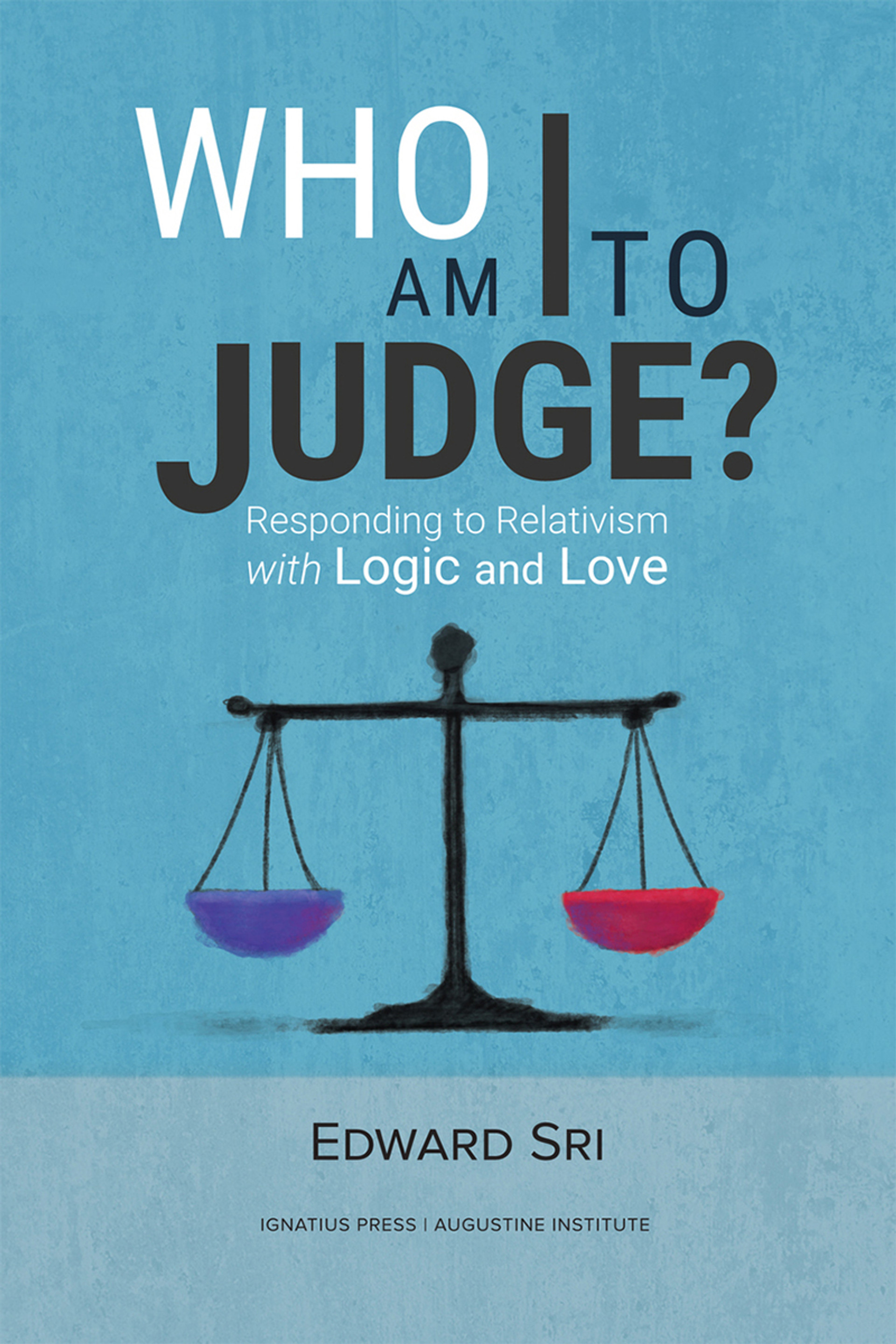
Who Am I To Judge? and DOCAT: What to Do?

Who Am I To Judge?: Responding to Relativism with Logic and Love.  By Edward Sri, Ignatius Press, 2016.


DOCAT: What to Do? – The Social Teachings of the Catholic Church.  Ignatius Press and Augustine Institute, 2016.


Who Am I To Judge? and DOCAT are both books that seek to make the teachings of the Catholic Church clear, accessible, and relevant to the readers.  Who Am I To Judge? is written by a professor of theology and scripture, who wrote this book to explain Catholic teachings to a wide audience, including young people who have grown up in a culture that sees claims to absolute truth as intolerant.  DOCAT is a collection of questions and answers to explain, justify, and defend various Catholic positions on a wide variety of issues.  These are books that have resonance to all individuals, but they are particularly geared towards younger Catholics, many of whom have never been exposed to a thorough defense of Catholic principles.


Who Am I To Judge? opens with a true story about a young Catholic college student who was bullied and publicly shamed for holding orthodox Catholic beliefs, and who rapidly came to embrace moral relativism as a means to protect her social standing and to avoid the condemnation of her peers.  Sri uses this anecdote as an example of the intellectual and moral culture of many college campuses, and extrapolates it to his own experience teaching.  In his introduction, Sri writes:


“Sixty-five college students every Monday, Wednesday, and Friday.  Most of them don’t want to be there.  How do I present the Christian moral tradition in a way that is captivating and compelling to these young people– especially when so many of them think of morality as a bunch of arbitrary rules from religion, assume each individual should be free to make up his own morality, and balk at the slightest hint that someone might be trying to tell them what to do?”


It should be noted that this is not a book that bashes the younger generation, but it does attack the broader culture, along with the pervasiveness of moral relativism, which contends that there is no absolute truth and that all individuals but determine what morality is right for them, and everybody’s personal definition of ethics is right for them.  Sri understands that this is a seductive worldview, allowing one to feel sophisticated and nonjudgmental.  Sri notes that when he was younger, he did not have the background education to properly understand and defend Catholic doctrine, but it was through a thorough guidance system that he was able to comprehend and embrace Church teachings, and now his career and this book intend to provide a source of information to a new generation.  He writes:


“Over time, thankfully, through good friends, mentors, teachers, priests, and books, I eventually came to see more clearly the beauty of the Catholic moral vision.  It makes sense out of life.  It points to what makes us truly happy.  It shows us the pathway to virtue, friendship, and lasting love.  It also encourages us to face the truth about ourselves– our faults, our weaknesses, our sins– in light of the truth about God’s unwavering love for us.  It thus leads us to a profound encounter with Christ’s mercy and to a power that enables us to live and love in a way we could never do on our own: the power of God’s grace.  Indeed the Christian moral life is the pathway to human flourishing.  Only by living the way God intended for us, by living in union with Christ, can our hearts’ deepest desires be fulfilled.


But that’s not the average person’s impression of Catholic morality and certainly not that of the majority of college students I was preparing to teach.  Most had been shaped by the culture’s individualistic outlook on life and came with the presupposition of moral relativism.  For them, morality was just personal opinion.  Each individual makes up his own truth.  Each decides for himself what is right or wrong.  The one really bad thing to do in life is to make a judgment about someone else’s moral beliefs.  That would be intolerant.”


Who Am I To Judge? is a sharp rebuke to moral relativism (and nihilism).  Sri explains that the purpose of his book is to provide logical answers to big questions.  The point here is to shift the boundary lines of the debate.  While Catholics are often on the defensive in discussions, Sri goes on the offensive.  He provides a series of counter-attack comments that cause the proponents of moral relativism to examine the basis of their own beliefs, and to illustrate that Catholic stances on issues are not merely medieval superstitions, but instead are logical and well-reasoned positions that can be justified through reasonable argument.


“This is the challenge that we will address in this book: How do we talk about morality in an age that no longer believes in moral truth?  If anyone making a claim to truth is viewed as an intolerant bigot, then how do we even begin to speak about some actions being wrong all the time?  After all, who wants to be perceived as a mean, judgmental person?  If I live in constant fear that I might be shamed for my moral convictions, then maybe it’s just better to keep quiet.


This short, highly readable book is meant to help you rise above the mainstream “anything goes” attitudes around you and give you greater clarity and confidence in talking about morality with relativistic friends– greater clarity about how to think with a classical moral worldview and greater confidence in sharing that beautiful vision with others.  I am convinced that the more we are immersed in a proper moral vision, the more effective we will be in responding to the relativistic mindset.”


Sri’s work is intended to help Catholics defend the tenets of their Church in a debate.  DOCAT is a resource consisting of questions and answers, organized by topic.  Love, the Church’s social mission, the human person, the Church’s social doctrine, the family, human work, economic life, politics, the international community, the environment, peace, and love in action.  Each section contains numerous questions that the both faithful and the doubtful might ask about morality or Catholic teaching, and then responds with a substantial reply of what the Church says and why it says it.


 DOCAT’s introduction states:


“The social doctrine of the Catholic Church contains a wealth of resources for how to live out the faith in pursuit of charity and justice.  DOCAT presents this social doctrine of the Church in a way designed specifically for young adults, helping you to respond effectively to Pope Francis’s challenge to work for greater justice in the world. 


Based on the Catechism of the Catholic Church and other important Church documents, DOCAT is written in a style and format just for you.  Through probing questions and thought-provoking exercises, DOCAT teaches how to understand and joyfully live according to the principles of truth, justice, and charity set forth in the social doctrine of the Church.


The truths of the faith are not meant to be merely an intellectual exercise– they are meant to make a real, tangible difference in daily life.  As Jesus tells his Apostles at the Last Supper, “By this all men will know that you are my disciples, if you have love for one another” (John 13:35).


What does this love look like?  It is loving your neighbor as yourself and praying for those who persecute you (cf Matthew 5:44).  It is giving food to the hungry and drink to the thirsty, welcoming the stranger, clothing the naked, and visiting the sick and imprisoned.  Love of God cannot be separated from service to others because when you care for others, you are serving God (cf Matthew 25:34-40).


Translated into multiple languages and distributed throughout the world, DOCAT can have a profound effect on young Catholics everywhere.  By learning to live a life transformed by God’s love, we can then, in turn, transform the world.”


DOCAT is interestingly designed.  The bulk of the text on each page consists of the question and answer format.  Lots of assorted pictures (mostly photographs) of a wide variety of subjects cover the pages, and on the sides of each page are quotes from numerous figures, not all of them Catholic.  Figures as diverse as G.K. Chesterton, George Bernard Shaw, Mohandas Gandhi, John Steinbeck, Albert Einstein, and scores of other notables are quoted.  Additionally, a series of little stick figure drawings are printed in the lower right corners of the odd-numbered pages, turning DOCATinto a flip book.


Both of these books are excellent resources, and can serve to educate and inform, because they are crafted in an extremely readable manner and advance their arguments clearly, firmly, and confidently.


–Chris Chan 

Saturday, March 23, 2024

Borrowed Time

Borrowed Time


Borrowed Time. By John Nolte, Bombardier Books, 2023.


Borrowed Time is a novel fueled by big ideas and the little moments that make up life.  It’s both an epic tale and a collection of miniatures, a story of an ordinary man with a supernatural ability that’s probably more curse than blessing.  Throw in a romance that’s both ordinary and extraordinary, a cast of memorable characters including some of the best-written villains in recent memory, and a serial killer with a grudge against all that is holy, and the result is one of the most resonant and powerful novels in years.


The central character is Joshua Mason, a man who’s average in every way save for his immortality.  Born millennia ago, he has made it into the present day as a perennial forty-something, never aging.  He can be wounded or killed, but immediately afterwards he comes back to life by an isolated tree in the desert, healed and whole. Mason has no desire to leverage his unique ability into fame or fortune or power.  All he wants is to exist, quietly savoring moments and trying to stay off the radar of those who might learn of his longevity and exploit it, though as the twenty-first century dawns, that grows increasingly challenging.


But after thousands of years of living forever with nothing to live for, Mason met Doreen, the proprietor of a motel in the American Southwest that’s barely staying afloat.  They married and enjoyed a simple but happy life, raising Doreen’s grandson Charlie, who was left severely mentally impaired after a car crash that killed his parents.  As they’re often in need of money, Mason has been forced to turn to drastic measures, selling himself to the rich and powerful who see homicide as a sport, knowing that for him, death is only a temporary inconvenience.  After a few decades pass, Doreen reaches the end of her natural life span, rejecting Mason’s offer of sharing his immortality as an unclean thing, leaving Mason adrift and responsible for Charlie’s care, with murderous forces converging all around them.


Gradually, more and more snapshots of American life are revealed, from the venal manipulators who use their influence to control and destroy others, to broader cultural cancers with the potential to crush millions of people.  Societal ills, human frailties, and larger movements with seemingly benign intentions and destructive results abound.  It’s a very dark story, but amazingly, it’s also a warm story, because even as Nolte targets everything that’s wrong with the world, he never loses an opportunity to illustrate how important it is to savor life’s moments of joy.  There’s plenty of danger and no despair.  At times, the forces of darkness in Nolte’s world seem unstoppable, but there are little lights of hope, humanity, and divine grace that make it clear which side will win in the end, even if so much of what people are obsessed with today is nothing but rapidly-fading vanity.


Nolte’s personal worldview is tightly intertwined with the story of Borrowed Time, but it never comes across as blatant message-pushing.  Whether it’s wonderment and horror at the leviathan nicknamed “the All at Once,” or bewilderment at the damage people inflict on themselves as a distraction, morality (not moralizing) is front and center in the story.  Taking tropes from other novels and putting his own personal spin on them, Nolte creates a man who “tends to his own garden” in a novel that’s more humane than Voltaire’s Candide, a dystopian government that’s as terrifying as Orwell but closer to our present reality, and a vision of the world’s end that’s told with Vonnegut’s wit but with more faith.


It’s the characters that make the novel shine.  There are fiends in human form but no saints, although there are several very good people who are striving to live virtuous lives in their own ways.  Interestingly, many individuals aren’t who they appear to be at first.  A seeming innocent is filled with inhuman darkness.  A ostensible slacker jerk turns out to be in the middle of a personal redemption arc.  An otherwise decent person is revealed to have done something that hurt someone else terribly, only for this transgression to rebound tragically decades later.  Borrowed Time also has plenty of brilliant villains, including a bureaucrat with ambitions for dictatorship, a vile plutocrat who’s disinclined to seek divine forgiveness and is cocky enough to believe that he can charm Satan, and a hit man filled with sleaze and self-loathing. Perhaps the biggest shortcoming in characterization is the case of a multiple murderer, where an insufficient attempt is made to explain why that person is so broken.  It’s a case where evil is left inexplicable.  In contrast, many other characters, some of whom are only around for a few pages, are given heartbreaking character arcs, explaining why they made terrible decisions that sent their lives into downward spirals.  For almost every other character, devastation and tragedy are the result of a deliberate choice to pursue selfish sins instead of decency and virtue, and while the main villain’s motives are explored, the ultimate cause of the never-healing wound needs more attention.  It’s one misstep in a remarkably well-crafted collection of characters.


Nolte has claimed that this is his first and only novel.  With such a powerful debut, one hopes that he changes his mind and keeps writing.

Friday, March 15, 2024

Catholics Confronting Hitler: The Catholic Church and the Nazis & A Man for Others: Maximilian Kolbe the “Saint of Auschwitz.”

Catholics Confronting Hitler: The Catholic Church and the Nazis.  By Peter Bartley, Ignatius Press, 2016.


A Man for Others: Maximilian Kolbe the “Saint of Auschwitz.”  By Patricia Treece, Marytown Press, 1993.


Catholics Confronting Hitler and A Man for Others are two books that discuss the role of the Catholic Church during the Second World War.  There is a prominent branch of historiography whose views have made their way into many popular culture venues which claims that the Church at best did nothing to fight the horrors of Nazism and at worst was directly complicit is the Third Reich’s crimes.  These books directly attack this perspective, using numerous anecdotes, quotes, and reinterpretations of various events in order to advance their contentions that large portions of the Church were active opponents of Nazism throughout the movement’s existence.


Bartley’s opening passages set up his thesis, as he describes the Vatican’s history and official pronouncements:


“Long before the Nazis came to political prominence, their ideology came under attack in the speeches of the papal nuncio Archbishop Pacelli before his recall to Rome in 1929.  Years earlier, the Church’s position on racialism and exaggerated nationalism had been made crystal clear, and by the highest authority.  In the encyclical Ubi Arcano Dei of 23 December 1922, Pope Pius XI proclaimed:


Patriotism… becomes merely… an added incentive to grave injustice when true love of country is debased to the condition of an extreme nationalism, when we forget that all men are our brothers and members of the same great human family.


The following year, anti-Semitism was repudiated in a sermon preached by the archbishop of Munich, Cardinal Faulhaber.  At the same time, Faulhaber addressed a letter to the chancellor, Gustave Stresesmann, complaining of “the blind raging hatred of our Jewish fellow citizens and other ethnic groups.”  Letter and sermon coincided with the failed Beer Hall Putsch and brought down on Faulhaber the special loathing of Nazis, who jeeringly designated him “the Jewish Cardinal.”  At his trial for his part in the putsch, Ludendorff launched into a lengthy tirade directed against the Catholic clergy for the protection they gave to Jews.  Stresemann, however, praised Faulhaber for his moral stance.”


While Catholics Confronting Hitler directly refutes many of the allegations levelled against the Church, it is important to note that the book does not serve as a whitewash.  While the leading figures and official pronouncements of the Church did much to fight Nazism, Bartley does devote a considerable amount of time to castigating self-professed Catholics who were active Nazis, and he also criticizes a priest who served as the leader of a central European nation and did very little to oppose Hitler.  


Bartley illustrates how the Church mobilized to create as united a front as possible in order to battle Nazism, writing that:


“The 1930 election result rang alarm bells within the Church.  The issue of Catholic membership in the Nazi Party, which until then had been left undecided, now became a matter of urgency.  Towards the end of the year, the senior German prelate, Cardinal Bertram of Breslau, published a statement critical of “false nationalism and the worship of race.”  He and the other bishops well knew that increasing numbers of Catholics were being drawn to National Socialism, whether out of sympathy with its patriotic appeal or because of its economic aims, while remaining largely ignorant of its fundamentally unchristian character.”


Catholics Confronting Hitler analyzes the relationship between the Church and anti-Semitism, and concludes that though many individual Catholics and Catholic communities, as well as some influential churchmen, have been highly hostile to Jews and involved in various persecutions; that there have been many other figures throughout Church history who have defended the Jews, and that particularly during the early half of the twentieth century, the popes and other prominent churchmen did much to combat anti-semitism.


“The anti-Jewish boycott provoked anger abroad and drew from the Holy See the first papal note of protest sent to Berlin.  Like many subsequent papal notes of protest, it was ignored.  According to the writer Sebastian Hoffner, who left a personal account of life in Hitler’s Germany, one effect of the boycott was to place the Jewish situation firmly in the public eye.  Germans who previously had given little thought to the matter now felt it necessary to have an opinion about Jews.  Invidious distinctions came to be made between “decent” Jews and the rest.


While the Nazis were hounding Jews and labour activists, an intense religious struggle was taking place.  Priests had their homes searched, Catholic government employees were dismissed from their posts, and a campaign of intimidation was begun against members of Catholic organizations, all within days of the passing of the Enabling Law.  The bishops protested these indignities in a letter of 1 April.  German Protestantism suffered from being fragmented.  Unlike the Catholic Church, which was international and hierarchical, the Protestant church was, as Konrad Heiden, Hitler’s first biographer pointed out, a German church to begin with.  Hitler’s task here was not to lure believers away from their church but to win them back.  The Lutheran church generally looked favourably on Hitler’s new order.  The die-hard conservatism of most Protestants made it difficult to accept a republic born of a coalition of Socialists and Catholics.  Many harboured sentiments of German nationalism, which, for some, sought expression in the movement of German Christians, a pro-Hitler wing of German Protestantism that aimed to adapt Christianity to neo-pagan race theory.  Originating in prewar Germany, the movement was energized by the advent of Hitler. Recalling Marcion of the second century, the German Christians aspired to a form of Christianity free of Old Testament influence, the more extreme among them wishing to “Aryanize” Christ.”


Overall, Catholics Confronting Hitler provides an excellent look at a complex and fascinating time for the Church, and contrary to a widespread narrative, the Church did much to distinguish itself by its actions.  Bartley advances the point that it was a dangerous, live-wire situation, where speaking out too loudly could have led to the deaths of thousands and led to the endangerment of millions.  It’s a compelling and in some ways overwhelming assessment of some of the world’s darkest hours.


While Catholics Confronting Hitler is a panoramic continent-wide view of the Church’s actions during the era of Nazism, A Man for Others focuses on one man’s personal story of moral courage and living by example.  A Man for Others is a biography of St. Maximillian Kolbe, a Catholic priest who died in Auschwitz.  When another prisoner escape, the Nazis ordered that numerous other prisoners be put to death as retribution.  When a younger man with a family was selected for execution, Kolbe stepped up and asked to be taken in the other man’s place.  Treece notes that it is entirely possible that the Nazi guards, who often indulged in cruelty and violence, could have simply decided to take both Kolbe and the other man, but instead the latter’s life was saved, and some of the later passages focus on that man’s life after being freed after the war.


Kolbe once declared, “The real conflict is the inner conflict. Beyond armies of occupation and the hetacombs of extermination camps, there are two irreconcilable enemies in the depth of every soul: good and evil, sin and love.”  While Kolbe’s famous sacrifice is at the center of the book, there are many other important incidents in Kolbe’s life that are also extremely interesting, such as Kolbe’s parents’ marriage, where they placed their faith over everything else, and his time in Japan.  There are many other little details that show what kind of man Kolbe was, such as his refusal to accept gifts of food without sharing them with all of the other prisoners.  


From international politics to one man setting a strong moral example, these two books are essential reading for a deeper and more nuanced understanding of the role that the Catholic Church played in the struggle against Nazism.  Both books center on what it means to cling to principles in turbulent times, and both narratives explain how faith can shape history.


–Chris Chan