Friday, May 19, 2023

Literary Converts: Spiritual Inspiration in an Age of Unbelief

Literary Converts: Spiritual Inspiration in an Age of Unbelief.  By Joseph Pearce, Ignatius Press, 1999.


Joseph Pearce has become famous for writing biographies of Christian literary figures, focusing on how their faith impacts their work.  Literary Converts is a collection of essays on numerous Christian authors from the late nineteenth and early twentieth centuries.  Many authors who are the subjects of Pearce’s full-length biographies, such as G.K. Chesterton, Oscar Wilde, J.R.R. Tolkien, appear in this work.  


In his introduction, Pearce writes:


“In 1905, the young G.K. Chesterton published Heretics, a volume of essays in which he precociously criticized many of his contemporaries, including, most notably, both Shaw and Wells.  One critic responded to Heretics by stating that Chesterton should not have condemned other people’s ‘heresies’ until he had stated his own ‘orthodoxy.’  Chesterton accepted the criticism and rose to the challenge.  In 1908 his Orthodoxy was published.  Its central premise was that the most profound mysteries of life and human existence were best explained in the light of the Apostles’ Creed.


Chesterton’s ‘coming out’ as a Christian had a profound effect, similar in its influence to Newman’s equally candid confession of orthodoxy more than fifty years earlier.  In many ways it heralded a Christian literary revival which, throughout the twentieth century, represented an evocative artistic and intellectual response to the prevailing agnosticism of the age.  Dr. Barbara Reynolds, the Dante scholar and friend and biographer of Dorothy L. Sayers, described this literary revival as ‘a network of minds energizing each other.’  Besides Chesterton, its leading protagonists included T.S. Eliot, C.S. Lewis, Siegfried Sassoon, J.R.R. Tolkien, Hilaire Belloc, Charles Williams, R.H. Benson, Ronald Knox, Edith Sitwell, Roy Campbell, Maurice Baring, Evelyn Waugh, Graham Greene, Muriel Spark, Dorothy L. Sayers, Christopher Dawson, Malcolm Muggeridge, R.S. Thomas, and George Mackay Brown.  Its influence spread beyond the sphere of literature.  Alec Guinness, Ernest Milton and Robert Speaight were among the thespians whose lives were interwoven with those of their Christian literary contemporaries...


Taken as a whole, this network of minds represented a potent Christian response to the age of unbelief.  It produced some of the century’s great literary masterpieces and stands as a lasting testament to the creative power of faith.  The story of how these giants of literature exerted a profound influence on each other and on the age in which they lived represents more than merely a study of one important aspect of twentieth-century literature.  It is an adventure story in which belief and unbelief clash in creative collision.”


Most of the authors receive a very brief mini-biography, followed by a more extensive look at their spiritual lives, and an overview of some of their most prominent works on religious themes.  Pearce opens his book with the unlikely conversion of Oscar Wilde.  Contrary to the widespread popular belief that Wilde was more concerned with wit and decadence than spiritual matters, Pearce relates evidence that shows that for most of his life,  Wilde was fascinated by Catholicism, although his eventual conversion occurred right before his death.  Pearce writes:


“However, there appeared little sign of Wilde showing any real inclination to join the Church himself until the final months of his life.  Shortly after his release from prison, having completed the two years’ hard labour imposed upon him in the wake of his ill-advised and abortive libel action against the Marquess of Queensberry, he had stated that ‘the Catholic Church is for saints and sinners alone.  For respectable people the Anglican Church will do.’”


Notably, some of the best and most interesting chapters focus on authors where Pearce has written a full-length book on the subject.  Authors like Chesterton and Belloc are very close to Pearce’s heart, and his second chapter, “Belloc, Baring and Chesterton,” reads as if he is describing dear friends. Pearce writes:


“When Sir James Gunn exhibited his famous painting, ‘The Conversation Piece,’ depicting G.K. Chesterton, Hilaire Belloc and Maurice Baring assembled round a table, Chesterton, which characteristic humour, labeled the three figures ‘Baring, over-bearing and past-bearing.’  Yet Gunn’s group portrait, which is now in the National Portrait Gallery, represented much more than a mere assemblage of friends.  The three literary figures were considered by the reading public to be inseparable in many respects.  They shared not only a common friendship, but a common philosophy and a common faith.  If not as indivisible as the Holy Trinity they were at least as indomitable as the Three Musketeers!  In the case of the Belloc-Baring-Chesterton chimera, the battle-cry of all for one and one for all is not inappropriate.”


Nearly all of the chapters are interesting, though the essays on obscure writers are less compelling, partially due to the subjects’ lack of prominence.  It is easier to get immersed in chapters where one is already a fan of the central figure.  One of the best chapters is on the actor Alec Guinness.  One of the few figures in the book who is not primarily a writer, Guinness’s chapter is a particularly lively read, and it makes one hope that Pearce will some day write a biography on Guinness with an emphasis on his movies with Catholic themes.  Another gem of a chapter is the one on Dorothy L. Sayers, which shows the author’s Christian apologetic work, for which she eventually abandoned mystery writing. 


The big question that arises from reading Literary Converts is “why aren’t these writers more popular?”  I submit that many of these writers are just as, if not even more talented than many of the leading modernist writers.  It seems to me that there are two main reasons why the subjects of Literary Converts occupy a niche status in twentieth century literary history.  The first is that there is a strong anti-religious strain amongst many influential critics and scholars which intentionally and unfairly marginalizes Christian writers.  The second is that there has not been a sufficiently powerful critical defense of the authors found in Literary Converts.


There is no reason why the subjects of Literary Converts need to remain relegated to niche status.  Throughout the early twentieth century, many of the leading authors, including some Nobel Prize winners, were Christian writers whose faith featured heavily in their work.  Many of these authors fell into obscurity because of a critical backlash against them.  It is true that many of the most celebrated modern writers are not traditionally religious, and it is certainly true that there is a strong secular bent to much of modern culture, but the reasons why these authors occupy such a high place in the literary pantheon is because influential critics and scholars put and keep them there.  The selection of canonical authors is largely subjective– the fans and supporters of the leading modernist authors promoted the authors they liked, and denigrated those that they didn’t.  The subjects of Literary Converts can receive more widespread appreciation through the creation of critical arguments explaining why these authors can be appreciated by everybody– not just Christians.


Literary Converts is a wonderful celebration of some marvelous writers, but it helps to reinforce the challenging restrictions of the “Catholic ghetto,” which makes talented writers of faith second-tier authors through no fault of the writers.  If Christian authors are going to receive more widespread respect, the whole “age of unbelief” needs to be met head-on, and attempts have to be made to expand the pantheon of “great” writers.  The subjects of Literary Convertsshould not be viewed as simply the best of the religious authors– they ought to be viewed as among the best of all the authors from their times.  The only way to break the unjust strictures of literary criticism is to create a strong and eloquent critical rebuttal, emphasizing that figures like Chesterton, Tolkien, Belloc, Lewis, Sayers, and more deserve a higher level of critical respect, and that perhaps some of the celebrated modernists need to be taken down a notch or two.


­–Chris Chan

Thursday, May 11, 2023

Priestblock 25487: A Memoir of Dachau

Priestblock 25487: A Memoir of Dachau.  By Jean Bernard.  Translated by Deborah Lucas Schneider.  Zaccheus Press, 2004; translation copyright 2007.


The atrocities of the Holocaust are well known, but many aspects of the horrors of the concentration camps are much more obscure. Many people are unaware that during the Holocaust, many Christian clergymen, including Catholic priests, were thrown into concentration camps. Many priests were vocal opponents of Nazism, and as a result more than two thousand priests became prisoners.


One incarcerated priest was Father Jean Bernard, a Luxembourg-born critic of Hitler’s regime who was sent to the infamous “Priestblock” in Dauchau, consisting of over three thousand men of the cloth, of which two-thirds were Catholic priests and the other third were assorted Protestant clergymen.  Bernard wrote short vignettes of his experiences, which were printed in the Luxemburger Wort soon after his release in 1945. The number “25487” was Bernard’s number in Dachau, meaning that he was the 25,487th person to be incarcerated there.  Since at the time of his entrance there were about 12,000 inmates in the camp, and a few thousand people had probably been freed, that meant that by the time Bernard reached Dachau, approximately 10,000 prisoners had died inside the camp.  In his forward, Bernard writes:


“I have agreed to make what I wrote then available in the present form, without any alterations, in memory of my fellow priests who died in Dachau– for we must never forget what happened there and in many similar places. Forgetting would be cowardice on the part of the people in whose name all these crimes were committed.  It would be a flight from our own consciences and from the indictment of the world, showing an unwillingness to make reparations and to atone.  And by not imputing such cowardice to them, we honor the German people. 


Wanting to forget would also be weakness on the part of those who suffered.  It would mean that even though they could endure suffering courageously, they now lack the inner strength to reflect on what they endured and to assess what it means for their own lives.  That amounts to a wish to forget, in order to make forgiveness easier.  And finally, it would be turning a blind eye to similar events taking place today, in full view, in many other parts of the world.


Yet we must forgive.  We must forgive while remaining conscious of the full horror of what occurred, not only because nothing constructive can be built on a foundation of hatred– neither a new Europe or a new world– but above all for the sake of Him who commands and urges us to forgive, and before whom we, victims and executioners alike, are all poor debtors in need of mercy.” (xix-xx).


The members of the clergy originally were treated less harshly than the other prisoners, being spared the harsher tasks and being treated with a certain level of respect by some of the guards.  Other guards, in contrast, treated the clergy with particular venom.  Since the inmates did not have access to news from the outside world, rumors spread quickly as to what particular events might have inspired the guards to become particularly angry or vengeful.  Bernard describes one such incident, writing that:


“None of us was ever able to say why the clergy block experienced this catastrophe, or to what was due.  Some people said that the Pope had given a strong speech on the radio, and that the German bishops had issued a public protest.  Something must have happened.  It was in early October 1941.


It began with the usual shout, “Everybody outside!”  We were hustled out into the barrack street.  Everyone with the few possessions he was able to grab in haste…


We are herded around like cattle, and when an SS man turns up, he curses and hits out, giving orders and countermanding them, just to make us jumpy and anxious and keep us in motion, so it looks like something is happening…


As we stand in front of barrack 28, Camp Commandant Hofmann addresses us.


Dear Reader!  To imagine this speech, take the most vulgar expressions you know, and put them in a pot with the greatest nonsense that you have ever heard a human being utter.  Add a few insults to the Pope and the Church, lard the whole liberally with “clergy scum” and “pack of priests,” and you have a rough approximation of the context in which the only message that really mattered appeared: “The privileges you’ve had up to now are over.” (53-55).


Many much more disturbing passages follow.  The terrible ravages of hunger are a recurring theme throughout the book, as the prisoners are forced to subsist on a fraction of a loaf of bread and a paltry measure of thin vegetable-based soup daily.  Bernard discusses the struggle to survive on starvation rations, and how he rationalized his pilfering potatoes from the Nazis’ stores with the commandment “Thou shalt not steal.”  Multiple instances of savage violence and bloody brutality are sprinkled throughout the memoir, along with the mental battles the guards waged in generally futile attempts to break the priests’ faith.  Towards the end of the war, disease was rampant throughout the camps, and the hospital’s general policy was to take anyone who was seriously ill, shove them into a room filled with other sufferers, deny them treatment and wait for them to die.  In many cases, mildly ill priests were denied treatment by special orders by the camp officials.  When the sick people died, they received little respect.  When Brachmond, a close friend of Bernard’s, died in the sorry excuse for a hospital, and Bernard wanted to see him, Bernard was told:


““The corpses aren’t gone yet.  But Brachmond is lying at the very bottom of the pile, and you can’t see much of him at all.”


I didn’t even try to get up, since I already knew what a pile of naked corpses looked like.  After their gold teeth had been knocked out, the dead of a given day were stacked like firewood in front of the barrack until the crematorium commando came with a cart to get them.” (158).


Priestblock 25487 was adapted into the acclaimed 2004 film The Ninth Day, with some fictionalized aspects added for the sake of dramatic effect and to explore the broader moral issues at play in a cinematic manner. The title of the movie stems in part from the highly unusual– and surprising– incident occurring in the middle of Bernard’s narrative. At one point, Bernard was set free for a ten-day leave in order to bury his mother. The first news Bernard had of her death was when he was temporarily released. Though Bernard was not under official surveillance when he was placed on this unprecedented temporary spell of freedom, he was obliged to return as soon as his time was up in order to ensure the safety of his fellow inmates. The title The Ninth Day refers to an imagined psychological and moral dilemma the protagonist (the priest’s name is changed in the film due to the multiple instances of artistic license) faces on day nine of his release.


In Night, Elie Wiesel’s famous autobiographical account of the Holocaust, there is a famous passage about how his concentration camp experiences “murdered [his] God” and crushed him mentally and spiritually.  Intriguingly, Bernard and his comrades appear to have experienced a completely opposite effect from their hardships, with their faith fully intact.  Bernard frequently mentions how much he misses performing his priestly duties, as well as the exhilaration and sense of renewal he feels on the rare occasions he is allowed to perform Mass in the camp, and during his extraordinary ten-day leave.  Priestblock 25487  is a horrific story showcasing the worst of humanity, but it is also a portrait some very good men who are striving to protect their souls and their dignity while they are being treated in an inhuman manner.


­– Chris Chan

Thursday, May 4, 2023

A School of Prayer: The Saints Show Us How to Pray

A School of Prayer: The Saints Show Us How to Pray. By Pope Benedict XVI, Ignatius Press, 2013.


Pope Emeritus Benedict XVI is famous for being a teacher as well as a pontiff.  Benedict XVI has received a lot of publicity lately for being the first pope in centuries to abdicate, but in all of the media coverage over his stepping down, precious little attention was paid to the massive amounts of theological scholarship Benedict XVI produced over his lifetime.


In A School of Prayer: The Saints Show Us How to Pray, his last book to be published during his pontificate, Benedict XVI describes the history of prayer, the psychological and social roots of prayer, and how Catholics can use prayer to make themselves better people and bring themselves closer to God.  This book is an anthology of recent essays and address by Benedict XVI, all of which revolves around the role of prayer in a Catholic’s life.


In the Introductory Note based upon a letter from May 4, 2011, Pope Benedict XVI writes: 


“Today I would like to begin a new series of Catecheses.  After the series on the Fathers of the Church, on the great theologians of the Middle Ages and on great women, I would now like to choose a topic that is dear to all our hearts: it is the theme of prayer, and especially Christian prayer, the prayer, that is, which Jesus taught and which the Church continues to teach us.  It is in fact in Jesus that man becomes able to approach God in the depth and intimacy of the relationship of fatherhood and sonship.  Together with the first disciples, let us now turn with humble trust to the Teacher and ask him: “Lord, teach us to pray” (Lk 11:1)


In the upcoming Catechesis, in comparing Sacred Scripture, the great tradition of the Fathers of the Church, of the Teachers of spirituality and of the Liturgy, let us learn to live our relationship with the Lord, even more intensely as it were at a “school of prayer.”


We know well, in fact, that prayer should not be taken for granted.  It is necessary to learn how to pray, as it were acquiring this art ever anew; even those who are very advanced in spiritual life always feel the need to learn from Jesus, to learn how to pray authentically.  We receive the first lesson from the Lord by his example.  The Gospels describe jesus to us in intimate and constant conversation with the Father: it is a profound communion of the One who came into the world not to do his will but that of the Father who sent him for the salvation of man.” (7).


Benedict XVI has rarely received the credit he deserves for his skills as a communicator and writer.  All of the essays in this volume are clear, concise, and convincing.  Benedict XVI writes with a quiet erudition and unwavering faith, and his voice is that of a man who seeks to bring people true happiness by strengthening their religious lives.  There is a warmth and subtle amiability in his words as he addresses his audience:


“Dear friends, in these examples of prayer of different epochs and civilizations emerge the human being’s awareness of his creatural condition and of his dependence on Another superior to him and the source of every good.  The human being of all times prays because he cannot fail to wonder about the meaning of his life, which remains obscure and discomforting if it is not put in relations to the mystery of God and of his plan for the world.


Human life is a fabric woven of good and of evil, of undeserved suffering and of joy and beauty that spontaneously and irresistibly impel us to ask God for that light and that inner strength which support us on earth and reveal a hope beyond the boundaries of death.” (12).


One of the central themes of this book is to emphasize the important role the prayer ought to play in someone’s life.  Many of the “new atheists” treat prayer as a habit passed on through superstition and ignorance.  Benedict XVI utterly rejects this view, stressing that prayer is an essential need for every human being’s mental and spiritual health.  Prayer, and therefore religion, is essential to making life worth living.  Benedict XVI expounds at length upon this point, writing that:


“We live in an age in which the signs of secularism are glaringly obvious.  God seems to have disappeared from the horizon of some people or to have become a reality that meets with indifference.  Yet at the same time we see many signs of a reawakening of the religious sense, a rediscovery of the importance of God to the human being’s life, a need for spirituality, for going beyond a purely horizontal and materialistic vision of human life.  


A look at recent history reveals the failure of the predictions of those who, in the age of the Enlightenment, foretold the disappearance of religions and who exalted absolute reason, detached from faith, a reason that was to dispel the shadows of religious dogmatism and was to dissolve the “world of the sacred,” restoring to the human being freedom, dignity and autonomy from God.  The experience of the past century, with the tragedy of the two World Wars, disrupted the progress that autonomous reason, man without God, seemed to have been able to guarantee.


The Catechism of the Catholic Church says: “In the act of creation, God calls every being from nothingness into existence… Even after losing through his sin his likeness to God, man remains an image of his Creator, and retains the desire for the one who calls him into existence, all religions bear witness to man’s essential search for God” (n. 2566).  We could say– as I explained in my last Catecheses– that there has been no great civilization, from the most distant epoch to our day, which has not been religious.


Man is religious by nature; he is homo religious just as he is homo sapiens and homo faber: “The desire for God” the Catechism says further, “is written in the human heart, because man is created by God and for God” (n. 27).  The image of the Creator is impressed on his being and he feels the need to find light to give a response to the questions that concern the deep sense of reality; a response that he cannot find in himself, in progress, in empirical science.


The homo religious does not only appear in the sphere of antiquity, he passes through the whole of human history.  In this regard, the rich terrain of human experience has seen the religious sense develop in various forms, in the attempt to respond to the desire for fullness and happiness.  The “digital” man, like the cave man, seeks in the religious experience ways to overcome his finiteness and to guarantee his precarious adventure on earth.  Moreover, life without a transcendent horizon would not have its full meaning and happiness, for which we all seek, is spontaneously projected towards the future in a tomorrow that has yet to come.” (13-14).


Despite his retirement, Pope Benedict XVI is certain to be a major figure in many people’s religious education for a very long time.  Most of the pundits and newscasters who reported on the final weeks of Benedict XVI’s papacy ignored his considerable written output.  Actually reading the works of Benedict XVI takes people beyond the shallow and ill-informed media coverage of the end of his papacy, hopefully strengthening the faith of his readers and increasing their respect for the man himself.


–Chris Chan

Thursday, April 27, 2023

The Wine of Certitude: A Literary Biography of Ronald Knox

The Wine of Certitude: A Literary Biography of Ronald Knox.  By David Rooney, Ignatius Press, 2008.


Monsignor Ronald Knox (1888–1957) was a prolific writer, working in theology, nonfiction, fiction, satire, and detective novels.  Knox’s literary career lasted for nearly half a century and consisted of scores of publications.  It is not surprising that with such a vast body of work that some of these books might become classics, while others remain largely obscure.  In David Rooney’s The Wine of Certitude: A Literary Biography of Ronald Knox, Knox’s entire literary corpus is listed, described, and explored in the hopes of introducing his work to a new generation of readers.


In his introductory pages, Rooney writes:                                                                            


“The time then may be auspicious for an overview of the full range of the mind of Ronald Knox, a fifty-year-later retrospective of a fifty-year career in letters, which commenced at Eton College in 1906 and was stilled only when death from liver cancer overtook him on August 24, 1957.  The present work is an intellectual portrait of the kind that I flatter myself might have qualified for the English Men of Letters series of a century ago.  The following pages do not attempt to add anything to the story of Knox’s life.  The first chapter is included merely to provide the reader who has not read either Waugh of Fitzgerald with a framework within which to peg chronologically Knox’s literary endeavors, which are segregated largely by subject matter in the remaining chapters.  Likewise, it does not purport to address his place in modern theology, a subject Father Walsh is far better equipped to analyze than I am.  It is instead a purely armchair survey of what Knox wrote in a variety of genres, with the attendant advantages and disadvantages of such an exercise.  The seasoned historian, and even more so the student of theology, who scans the footnotes will no doubt find too frequently the reference to a less-definitive study on some topic, read and cited merely because it happened to occupy a more convenient place on a home or institutional bookshelf.  On the other hand, armchair readers will find that most of the references are to books available in reasonably large university libraries, and none to manuscripts or letters rendered practically inaccessible to them because they repose in out-of-the-way archives, or for that matter to books written in tongues the author is insufficiently conversant in to read more rapidly than at the pace d’un escargot.”(9-10).


Understandably, in order to describe Knox’s work adequately, Rooney has to quote Knox extensively.  Rooney is fully aware of how much of his book are his subject’s words and not his own.  Indeed, The Wine of Certitude is as much an anthology of “the best of Knox” as it is a criticism or synthesis of the man’s work.  Rooney explains his approach to the material, writing that:


“The reader will observe too that around one-quarter of this book was actually written by Knox himself, so frequent and so lengthy are the quotes included in the text.  Indeed, in writing and assembling it, I have often considered the work in light of the “mosaic” approach used by the great contemporary historian Emmet Larkin, who so skillfully has patched together extensive extracts from Irish bishops and other personages to make the period from 1850 to the early twentieth century in Irish ecclesiastical history emerge so vividly from the printed page in his multivolume series.” (10).


One of the major problems with writing a review of a massive literary career is that it can be very difficult for readers unfamiliar with the subject’s work to follow all the references to books they have never read, and possibly never will read.  Rooney circumvents this potential stumbling block by refraining from crafting his book as a series of capsule summaries, and instead develops the book as the gradual development of Knox’s literary corpus.  A large portion of this book is devoted to finding Knox’s place in the canon of twentieth century literature, and Rooney compares Knox to numerous other Catholic writers, particularly those who are members of the clergy. 


“Evelyn Waugh insisted on seeing in Knox’s career many similarities to that of John Henry Cardinal Newman, but Knox himself seems to have regarded the life of Robert Hugh Benson as a more suitable template for his own.  Yet whichever of these convert priests is chosen as a yardstick, one is at a loss to find a parallel in the writings of either of them with Knox’s use of the light novel as a literary vehicle.  The historical novel, to be sure, was Benson’s staple, and Newman composed a few of them himself, but such works as Loss and Gain were written with an evident apologetic aim.  Of the three novels Knox wrote in the 1920’s (not counting the detective fiction he would soon become an adept at writing), two of them appear at first glance to be pure fantasy, while the third is a conscious imitation of a nineteenth-century classic.  The fantasies revolve around subjects of topical interest in that decade and no doubt were read simply as such by some devotees of the imaginative novel.  But they are all in fact expressions of Knox’s willingness to use any genre, however popular, to nudge even the casual novel reader to serious reflection.” (81).


A book like this cannot succeed if the author does not demonstrate real enthusiasm for his subject, and Rooney has a knack for always making Knox appear like someone who is worth reading.  Rooney fills his book with quotes from Knox not to merely take up space, but to offer the reader little samples of Knox’s work in order to whet the reader’s appetite for discovering more about the author.


“There are over forty thousand words taken from Knox’s writings in the present book, but they represent well under 1 percent of his published output.  The other 99 percent is of the same quality.  The reader need only randomly consult any of his books to verify that assertion.  He was a consummate writer: every word in its place, every sentence carrying forward an argument or an image, every thought intelligible and, far more often than not, compellingly persuasive.  If the present work does not encourage the reader to seek out and read a book written by Knox, and not just a book aboutKnox, it will have failed in its intent.” (11).


The ultimate goal of a work such as The Wine of Certitude is to make readers aware of a widely overlooked literary treasure and to encourage people to read Knox’s work. The best way to make people appreciate a writer is to describe how good he is, and Rooney certainly succeeds in helping people appreciate a man with a great power for the written word.  Personally, Rooney made me anxious to start reading more of Knox’s books, particularly his mysteries.  Therefore, Rooney has succeeded in his intent in writing this book.


–Chris Chan

Friday, April 21, 2023

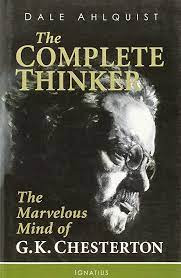
The Complete Thinker: The Marvelous Mind of G.K. Chesterton

The Complete Thinker: The Marvelous Mind of G.K. Chesterton.  By Dale Ahlquist, Ignatius Press, 2012.


Dale Ahlquist is the president of the American Chesterton Society (ACS) (http://www.chesterton.org/), which is dedicated to promoting the life, works, and philosophy of G.K. Chesterton to the world.  Ahlquist has previously written the books G.K. Chesterton: The Apostle of Common SenseCommon Sense 101: Lessons from G.K. Chesterton, and has edited and introduced many other books about Chesterton.  As part of the ACS’s efforts to fix the world’s ills, Ahlquist hosts the EWTN television series The Apostle of Common Sense, (http://www.ewtn.com/series/chesterton/index.htm), and many of the essays in Ahlquist’s latest book, The Complete Thinker: The Marvelous Mind of G.K. Chesterton are adapted from the scripts of several episodes of the series.


In his introduction, Ahlquist writes:


“What is it that sets Chesterton apart, besides the fact that he is totally quotable?  For one thing, he differs from some other outstanding literary figures of the last century in that he answers questions instead of just asking them.  There are some fine artisans of the written word, skilled evokers of stirring and striking images, but their ideas are often disconnected, detached, and even decayed– a wilt that is lovely but suggests a lack of rootedness.  Or, to switch metaphors, the fog they are lost in is sometimes interesting and eloquent, but it is still a fog and they are still lost in it.  They express the problem very well– they write of the dilemma articulately– but they cannot find their way out.  They do not have  a solution.  Their suggestiveness can only suggest.


But G.K. Chesterton is enormously clarifying.  In an age of relativism, he speaks in absolutes.  He speaks the truth without uncertainty, without wavering, and without embarrassment– and without the anger and pride that can befoul even the truth.  He speaks with graciousness and goodness and humility. His epigrams ring with an instantly recognizable truth.  But he does not merely sprinkle little encapsulated truths; he gushes with an ocean of truth.  It is the whole truth.  It is a comfort to most, a curiosity to some, and a curse to a few, but no honest reader can shake off the notion that Chesterton is consistently, extensively, and astonishingly right in what he writes.” (13).


Arguably the primary purpose of Ahlquist’s continuing attempts to popularize Chesterton is the belief that Chesterton is the antidote to most of the problems that plague today’s world.  Not only is Chesterton a better writer stylistically than most of the pundits and critics employed today, but his predictions and warnings also been proven correct more often than his celebrated contemporaries.  Ahlquist stresses how Chesterton’s warnings about societal breakdown and unrest have gone largely ignored or dismissed, and that rejecting Chesterton’s messages may come at a high cost, writing that: 


“It seems that one of Chesterton’s main functions is to remind us of things we already know: common sense.  “Every high civilization decays,” warns Chesterton, “by forgetting obvious things.”[i]  What better description of the present state of our civilization?  He prophetically points out that this decay includes a loss of respect for marriage, family, private property, and the value of life itself.  He says human rights will be respected only when they are treated as divine rights.[ii]  But we are not allowed to discuss the divine origin of rights, or of life, or of existence.  We are hardly allowed to discuss existence at all.  And Chesterton asks, “If the ordinary man may not discuss existence, why should he be asked to conduct it?”[iii]” (15).


The essays in The Complete Thinker are all easy reads, ranging from about ten to twenty pages each.  Most are opinionated, but being argumentative is not the same as being aggressive.  One of the most unappreciated aspects of Chesterton’s character comes from his treatment of those who disagree with him.  Ahlquist observes that Chesterton’s ultimate goal was not to win mere debates, but to win over souls:


“We can learn from Chesterton not only how to be a complete thinker but how to argue with our adversaries.  He is the model of calm and reason and good humor, not only because he is confident about the truth, but because he cares about the souls of his opponents.  He wants to win them over because he loves them, not because he merely wants to prove that he is right.  He always sees the connection between truth and charity.  It is part of his completeness.” (18).


There are seventeen chapters in The Complete Thinker, covering topics as diverse as “How to Think,” “The Problem of Evil,” “The Seven Deadly Sins,” “War and Peace,” “Politics and Patriotism,” “Life and Death,” and “Abandon Hopelessness, All Ye Who Enter Here.”  Also fascinating is the appendix “Chesterton vs. Darrow,” an account of the famed debate between Chesterton and the renowned lawyer Clarence Darrow, where Chesterton was widely viewed as the clear victor.  Though no transcript was taken of the debate, the recollections of several observers are pieced together in order to reconstruct this fascinating face-off.


Ahlquist repeatedly justifies his support for all things Chestertonian, stating early in the book that:


“Although Chesterton writes about everything, he makes this striking claim: “There is only one subject.”[iv]  There is one central truth, to which all other truths are connected, and which is under attack from all sides by error, by mistakes, by foolishness, by sin.  Chesterton understands that in defending this truth he has to be prepared to talk about everything.  And so that is what he talks about– everything.  He is also willing to argue, to fight.  “If you are loyal to anything and wish to preserve it, you must recognize that it has or might have enemies; and you must hope that the enemies will fail.”[v]


For the last three decades, I have enjoyed not only taking an active role in the Chesterton revival, but simply watching it as well.  The greatest privilege has been watching the endless parade of Chesterton’s words march by and present themselves for inspection, watching the wheels of his great mind turn as he considers the truth that touches everything, watching the winds of his great soul blow away all the intellectual garbage and strange and horrible ideas that clutter the modern world, and watching his sure hand as he defends the faith that changed his life, the faith that changed my life.  There is a reason he writes with such strength and assurance.  As he points out, “faith” and “confidence” are derived from the same word: fides.  Chesterton is a giant of the faith, and a model of confidence in the truth.  He puts it all together.”  (19-20).


Though The Complete Thinker is filled with Chesterton quotes, Ahlquist adds a number of great lines of his own, such as, “The modern version of tolerance is the idea that it does not matter what you believe as long as you do not really believe it.” (103).  The Complete Thinker is meant to be a companion volume to the earlier G.K. Chesterton: The Apostle of Common Sense and Common Sense 101: Lessons from G.K. Chesterton, since Chesterton is far too vast an author to be confined to one book.  The Complete Thinker is geared towards both readers with a minimal knowledge of Chesterton as well as Chesterton experts, as well as anybody who wants a fresh view of the most controversial issues of our time.  If one is already a Chesterton fan, The Complete Thinker is a fine way to add to one’s appreciation of Chesterton.  If one is unfamiliar or negatively disposed towards Chesterton, this book may win him some new fans.


­–Chris Chan


[i] The New JerusalemCW 20:211.

[ii] Illustrated London News, January 13, 1912.

[iii] George Bernard ShawCW 11:482.

[iv] ILN, February 17, 1906.

[v] ILN, January 29, 1911.

Friday, April 14, 2023

Edith Stein and Companions on the Way to Auschwitz

Edith Stein and Companions on the Way to Auschwitz.  By Father Paul Hamans, Ignatius Press, 2010.


The general atrocities and horrors of the Holocaust are well known, but many of the millions of victims’ stories are not common knowledge.  Father Paul Hamans’ Edith Stein and Companions on the Way to Auschwitz consists of a series of portraits of Holocaust victims that were linked by the fact that they were Jewish people who had become Catholic.  It is important to realize that the Nazi’s genocidal policies were based on race, not religion.  Conversion often did not provide any protection from the Nazis, as the murders of this book’s subjects prove.  In his opening, Hamans writes:


“The Nazis wanted to exterminate all Jews.  This group of Jews who had become Catholic forms a separate whole. They became companions because they were arrested and murdered for the same reason.  On July 26, 1942, the Dutch bishops, together with the Protestant denominations, publicly protested against the deportation of Jews.  In retribution, the Nazis had more than four hundred Catholic Jews rounded up.  Many were soon released, but 113 were murdered.  The most well-known of them is surely the Carmelite nun and philosopher Edith Stein, who was canonized by Pope John Paul II on October 11, 1998.  It is also widely known that her sister Rosa suffered the same fate.


For the first time in the English language, a still incomplete list of Edith Stein’s eighty-two travel companions to Auschwitz is published in the present work.  The lives of twenty-eight of these murdered Catholic Jews are depicted by means of individual biographies.  In the interest of historical authenticity, the biographies were based, whenever possible, on accounts of those who saw and heard the events firsthand… For the most part, the Catholic Jews portrayed here are people who embraced the Catholic faith when they were older.  They chose very consciously to be faithful to Jesus Christ and his Church.  Theirs was a fidelity that was sustained by a great spirit of sacrifice unto death.” (xi-xii).


Embracing Catholicism often caused the converts to become estranged from their families and friends.  “The life stories of the individuals recounted in this volume reveal how much their baptism cost them: problems with their families, loss of social status, impoverishment, misunderstanding, and the sacrifice of their lives.”  (xiv).  Edith Stein and Companions covers the lives of over two dozen Catholic Jews.  The title character, also known as Saint Teresa Benedicta of the Cross, O.C.D. (O.C.D. stands for Ordo Carmelitarum Discalceatorum, not obsessive-compulsive disorder), is by far the best-known historical personage in this volume, though every life recounted here is worth studying.


In general, most of the lives profiled in this book follow a similar pattern.  Most of these individuals were raised Jewish, but were drawn to Catholicism through various ways.  A few of these subjects were children of converts to Catholicism.  Hamans differentiates the lives of his subjects well.  Edith Stein, being such a notable intellectual and writer, has one of the most interesting biographies, as we learn about her scholarly studies.  Many of the other subjects led lives of quiet contemplation and prayer, and a few others suffered from turbulent home lives in the wakes of their conversions.  Some of these people might have had a chance to immigrate and escape the Holocaust, but did not for various reasons, such a reluctance to abandon their religious communities.  Unfortunately and tragically, all of these stories end the same way: the subjects were murdered at Auschwitz.


“On August 2, 1942, the Nazis arrested a large number of Catholic Jews in the occupied Netherlands and sent them to their deaths at Auschwitz.  The provocation for this action was a pastoral letter that had been read in Catholic churches on the previous July 26.  This letter included the text of a telegram that had been sent by the leaders of ten Christian denominations to the German occupying forces on July 11.  Both the pastoral letter and the telegram protested the persecution of Jews in the Netherlands.


From various sides, the question has been raised whether these murdered Catholic Jews can be considered martyrs for the Catholic faith.  Some respond that they cannot because, as they rightly point out, the Nazis had already determined to exterminate all Jews, and Catholic Jews were not exempt.  The Catholic Jews were not murdered because they were Catholic, this position maintains, but because they were Jewish.  This argument does not, however, do full justice to the reality.  While Catholic Jews woulf have been murdered even without the telegram and pastoral letter, there are significant arguments for considering them a separate group, distinct from the other Jews who were killed during the Holocaust.  That they are blood witnesses for Catholic faith and morality is precisely what sets them apart.” (1-2).


Though this is heavy and heartbreaking subject matter, often these stories of faith and moral courage are inspiring.  These people shared more than identical fates, they also shared deep and powerful faiths.  The book is filled with quotes and anecdotes filled with their professions of belief, as well as statements from members of the Catholic clergy denouncing the Nazis.  Unfortunately, the Church’s attacks on the Nazis led to the Nazis seeking revenge, which spurred the murders described in this book.


“The Catholic Jews who were arrested on August 2 form a distinct group because their deaths can be directly linked to actions taken by the Catholic bishops in the Netherlands.  The occupying forces made the decision to arrest Catholic Jews on July 27 because the bishops had stood up for human dignity and human rights in accordance with their Catholic vision of man.  General Commissioner Fritz Schmidt made this motive publicly known on the day of the arrests.  They were taken prisoner, he explained, because the bishops had protested the treatment of Jews in general, instead of restricting themselbes to concern for Catholic Jews.  Edith Stein’s canonization demonstrates that the highest authority of the Church considers hers to have been the death of a martyr– willingly suffered for the Catholic faith.  Her companions on the way to Auschwitz died as Catholic Jews just as she did because the Church in the Netherlands, through her bishops, dared to defend the Jewish people in the name of Christ.” (2).


This book is not easy reading, but the oft-cited dictum about those who do not remember the past are doomed to repeat it applies here.  Edith Stein and Companions on the Way to Auschwitz is both a history book and a work of hagiography.  It is collection of profiles of the best of humanity in a world that was increasingly controlled by the worst of humanity.


­–Chris Chan

Thursday, April 6, 2023

The Heart of Catholic Prayer

The Heart of Catholic Prayer.  By Mark P. Shea, Our Sunday Visitor, 2012.


Prominent Catholic writer Mark P. Shea, best known for his blog, “Catholic and Enjoying It!” (http://www.patheos.com/blogs/markshea/), is well-known for making theology and religious history clear and accessible to a contemporary audience.  Shea’s trilogy on the Virgin Mary, Mary, Mother of the Son, was reviewed here in March, April, and May of 2011.  Shea’s most recent book is The Heart of Catholic Prayer, a short but wonderfully informative volume explaining the history and significance of Catholicism’s two most prominent prayers, the Our Father and the Hail Mary.  In this book, Shea explains the true nature of prayer and argues against common misconceptions about what happens when we pray.


“Because we don’t know what we are doing when we pray, God sends us help.  The principal help he gives is the Spirit, who, if you will, prays through us and in union with us.  That doesn’t mean we are empty vessels and that every prayer that pops into our head is an oracular utterance of the very mind of God.  It means that God the Holy Spirit guides and helps us to pray more and more like Chris in the power of his Sonship.  That, in turn, directs us back to the fact that Christ is our teacher in the school of prayer, especially in and through his inspired word in Scripture and in the liturgy of the Church, since the Mass is the highest form of prayer.  With his disciples, we say, “Lord, teach us to pray!”– and he does.” (11)


In The Heart of Catholic Prayer, each line of the Our Father and the Hail Mary receives its own chapter.  Each chapter is only about ten pages, making the book easy reading, especially for people who are trying to study religion with limited free time.  It may be daunting to read a lengthy volume, but it is easier for many people to set aside several minutes a day to read just one short but information-filled chapter.  In just a few paragraphs, Shea is able to explain away a common misconception about Catholic prayer practices such as the rosary:


“When we turn to Christ’s teaching on prayer and the fact of the liturgy, we discover something odd: one of the many curiosities of the Christian tradition is that when Jesus undertakes to teach about prayer, he begins by waving us all away from meaningless repetitive prayer: “And in praying do not heap up empty phrases as the Gentiles do; for they think that they will be heard for their many words” (Matthew 6:7).  But in the next breath, he gives us a prayer that he obviously expects us to repeat, a prayer we have indeed repeated for almost two thousand years– the Our Father.  Is this a contradiction?


No.  Jesus is warning against meaningless repetition, not meaningful repetition.  In this warning, he has in view a sort of magical notion of prayer, in which we can somehow gain power over the unseen by mere repetition or by saying just the right incantation so that God has to knuckle under to our will, like a genie.  It reduces God to something like a capricious sprite who spends his days scrutinizing trivialities (“Was that ten Hail Marys you said this decade or only nine?  Denied!”), rather than a God who is Father and filled with love for his children.  There’s something at once childlike, superstitious, and savage in such a picture of prayer, but you’d be surprised how easy it is to fall into.” (12).


What makes The Heart of Catholic Prayer such a valuable resource is the way that Shea is able to make a complex and often daunting topic comprehensible and digestible for the average reader.  Shea is equally comfortable referencing diverse topics such as religious historiography, the contemporary blogosphere, writings of early Christians, and Buffy the Vampire Slayer, all in the same chapter.  It creates an intriguing amalgam that makes the book readable without ever descending into “pop” theology.  He is always clear without being simplistic, such as when he outlines the relevance and importance of each prayer.


“[T]he Hail Mary is profoundly the prayer of a disciple.  Like the Rosary of which it forms such a vital part, it is a prayer ordered toward looking at Jesus through the magnifying lens of Mary’s life.  But it is also a prayer that teaches us to see Mary as the greatest recipient of grace, as well as our model and Mother in how to live out that life of grace in our day-to-day walk with Christ.  It is a prayer that strings together the basic biblical teachings about Mary and quotes freely from (1) Luke’s infancy narrative; (2) the Council of Ephesus, which declared Mary to be the “Mother of God”; and (3) the cry of the Catholic heart that she stand by our cross of death as she stood by Christ’s.” 


Mary is the disciple who sticks with us in our wretchedness when all others have forsaken us, just as she stuck with Jesus.  What the Hail Mary is not is a prayer that Mary take the place of God.  The whole point about her is not that she is a goddess who stoops down to us and “empties herself” as Jesus did, but rather that she, being a mere mortal, is exalted by the grace of God to sit in the heavenlies with the Son of God.” (15).


This book is more than just explaining the meanings of two prayers.  It also explains why prayer is essential to the life and soul of Catholics who take their faith seriously.  Shea concludes his book with the following passages:


“In all this, the Our Father and the Hail Mary keep us on an even keel and remind us that at the heart of the faith is the heart or, more precisely, the two hearts of God and his Bride.  Jesus, of course, has a heart that beats as one with the Father’s heart.  Indeed, he is the heart of the Father.  Jesus’s humanity is at one with the Father, God in him and he in the Father; but though the focal point of Christian faith is the heart of God revealed in Christ Jesus, it is not the totality, just as the totality of a wheel cannot be the hub alone.  


What I mean is this: Christianity is about salvation.  Jesus’ very name means “The Lord is Salvation.” But though the heart of God is Jesus, Jesus is not the one being saved.  We are.  So our hearts must enter into the picture as well.  Our hearts must be in Jesus’ heart, and he in ours.  That is why the Hail Mary is constantly paired with the Our Father in the Church’s devotional life, especially in the Rosary.


It is not enough that Jesus triumphed over death and ascended to heaven.  If nobody goes with hi,, the whole exercise was a pointless waste of time.  In the Hail Mary, we are perpetually reminded that the human heart Jesus took with him to heaven bore within it the heart of the human being who loved him more than anybody else– and that she followed her heart all the way to heaven.  We are given the glad news that we can do the same, as many already have, if we but place our heart in theirs and join in their love for each other.  In Jesus, who is the Heart of the Father, and Mary, who gave Jesus both his human heart and her own heart as well, we find our salvation.” (151).


On the magnificent British cooking show Two Fat Ladies, the co-hostess Clarissa Dickson Wright once observed that, “There are fifty-six words in the Lord’s Prayer and 2,600 in the EEC (European Economic Community) regulations of the export of duck eggs.”  This quip illustrates how concisely the central prayer of Christianity is phrased, whereas contemporary bureaucracies utilize verbosity to promote triviality.  Mark Shea brilliantly– and enjoyably– explains how every word in the Our Father and the Hail Mary is important, and how the whole of each prayer is so much more than the sum of its parts.


–Chris Chan